ChatGPT ads are now live in Australia. Here's what they are, how they work and what that means for small business owners weighing up where to spend.
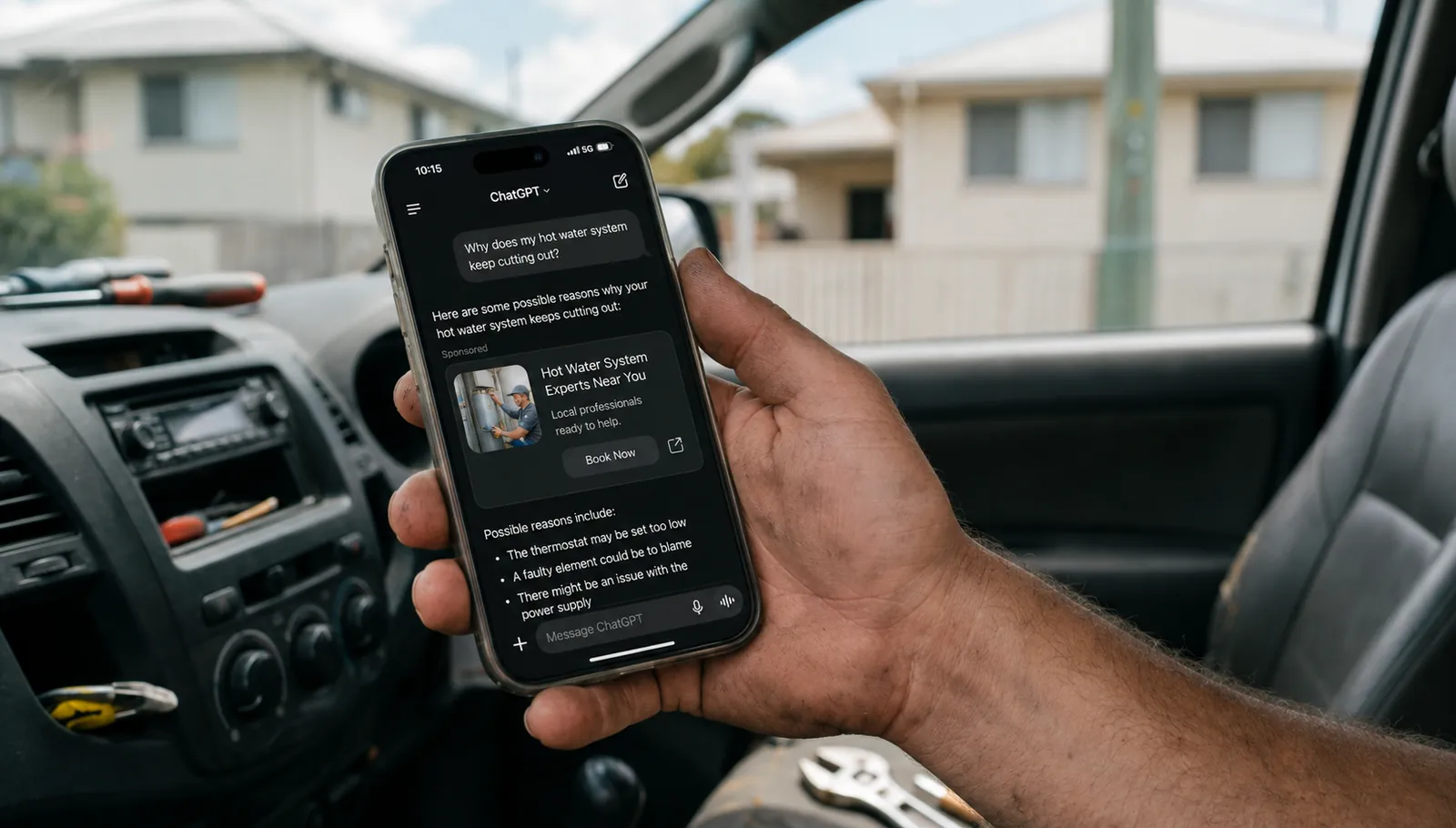
Somewhere between you asking ChatGPT to write a birthday speech and asking it why your hot water system keeps cutting out, an ad slipped in underneath the answer.
That's not a glitch. It's the new normal.
OpenAI now shows ads to eligible ChatGPT Free and Go users in Australia. Its self-serve Ads Manager Beta is open to Australian advertisers, with tools for bidding, budgeting, creative and conversion tracking built in. No minimum spend and no long setup process. Anyone with a payment method and a campaign idea can get one running.
Even if you've got no intention of touching this yet, it's worth understanding. The chatbot has officially joined media. That changes how people find businesses, whether you buy an ad or not.
What ChatGPT Ads Look Like
An ad in ChatGPT sits in a clearly labelled, tinted box underneath the AI's answer. It doesn't change what the chatbot tells you. OpenAI is firm on that point: ads don't influence the response above them, and advertisers never see the conversation that triggered the ad.
That's a different deal to what you're used to with Google. Search ads sit above or beside organic results, competing for the same click. ChatGPT ads sit after an answer someone already got. The person isn't hunting anymore. They've been given information, and now there's a business offering to help them act on it.
Targeting works on context, not just keywords. Google catches "plumber Geelong" because someone typed those words. ChatGPT catches the conversation itself, so a Geelong plumber's ad might appear under a chat about a hot water system that's been cutting out for a week, without the word "plumber" ever showing up.
That's a richer signal in theory. Whether it converts into a phone call is a different question entirely, and one worth testing carefully rather than assuming.
Why This Isn't Google Ads With a New Coat of Paint
Google Search still catches people the moment they need help right now. A burst pipe at 11pm sends someone straight to a map and a phone number, and Google Business Profile is built for exactly that kind of urgency.
Not sure what to fix first?
Book a free 30-minute strategy session
ChatGPT tends to catch a different moment. Someone comparing loan options, researching kitchen renovation styles, or trying to work out what might be wrong with an appliance, isn't ready to book yet. They're still thinking things through.
Every business has customers moving through both moments at different times. The same person weighing up options this week might be searching for a same-day fix next month. That's not a reason to choose one channel over another. It's a reason to have a presence across the moments that matter, and let each channel do the job it's built for.
The Basics of How It Works
Setting up a campaign in Ads Manager Beta follows a familiar shape if you've used Google or Meta before: campaign, ad group, ad. Bidding runs on cost-per-click or cost-per-thousand-impressions, and clicks currently sit somewhere in the $3 to $5 range depending on the market and the moment.
Privacy is where it looks different. Advertisers get aggregated performance numbers only. No names, no chat history, no email addresses. You'll see views and clicks. You won't see what anyone typed.
That's good news for the person asking ChatGPT about their symptoms or their finances. It's a genuine limitation for the business trying to work out whether a click turned into a paying customer, at least for now. Measurement tools are still catching up to what Google Ads and Meta offer, and that gap is worth factoring into any decision about spend.
What Matters if You're Curious
The temptation with any new ad platform is to treat it like a race. Get in early, beat the competition, ride the algorithm before it gets expensive. Sometimes that pays off. Just as often, it means paying to learn lessons a slower business gets for free six months later.
A more useful question than "should I be on ChatGPT ads" is "can I tell whether this is working." That depends less on the platform and more on what's already happening inside your business. If a call comes in and nobody answers it for two days, a new traffic source won't fix that. If nobody's tracking where enquiries come from, adding one more channel just adds one more thing nobody can measure.
Businesses that get something out of early platforms tend to share a few things in common. They already know their numbers on their existing channels — what a lead costs through Google, what a booking's really worth. They can answer new enquiries quickly. And they're willing to treat a first campaign as a genuine test, with a fixed budget and a clear point at which they'll walk away if it isn't working, rather than a subscription they forget to cancel.
A dashboard full of clicks looks like progress. It isn't the same as a phone ringing.
Judging It Without Fooling Yourself
Clicks and impressions feel like progress. They aren't the same as a booked job.
The businesses that get this right track everything back to an outcome that matters — a call, a form, a booking — and tag the source so it doesn't get lost in the noise. A dedicated phone number or a tagged form field does more for a small test budget than any dashboard OpenAI provides.
Cost per click is close to meaningless on its own. Cost per qualified lead — someone in your area who wants what you sell and can realistically buy it — tells you something. Compare that against what your Google or Meta campaigns already deliver, and you've got a benchmark that means something to your business specifically, not a benchmark borrowed from a case study about a business nothing like yours.
If leads arrive from outside your service area, or turn out to be people asking questions rather than people ready to buy, that's useful information too. It's just not the information anyone wants to see after spending money.
Where This Sits Next to What Already Works
Nothing about ChatGPT ads replaces Google Ads, Meta or a well-run Google Business Profile. It is an additional room in the house, not a renovation of the whole thing.
The businesses getting the most out of it are the ones who kept their existing channels funded while they tested something new, rather than pulling budget from a campaign that was already booking jobs to chase a platform that's still finding its feet. A new channel earns a bigger slice of the budget once it's proven something, not before.
Don’t raid the budget that keeps your phone ringing. If Google Ads delivers booked jobs for a Darwin pest controller, keep it running while ChatGPT gets a small side test.
We've watched the same pattern play out with pretty much every new platform that's landed over the years. The platforms change. What separates a good result from a wasted one rarely does: know your numbers, answer your leads, and don't bet the farm on anything until it's earned your trust.
ChatGPT ads are new, genuinely new, and worth understanding regardless of whether you spend a dollar on them this year. Whether they're worth your budget depends on your business, your customers and how quickly you can turn a click into a conversation that goes somewhere.
New platforms are worth watching, but most businesses get more out of making sure their existing marketing is pulling its weight first. A free strategy session with one of our specialists is a good place to see where your budget's working hardest right now.