Skip to content
All articles

Small business basics

How to Use QR Codes for Your Australian Small Business (2026 Guide)

21 June 2023 · 8 min read · Sonya Millan

Updated 5 June 2026

Australian small business owner displaying a QR code on a table tent and customer scanning it with a smartphone.
S

Sonya Millan

21 June 2023 · 8 min read

Generate a QR code in 30 seconds, but most Aussie SMBs use them badly. The static vs dynamic decision, five genuinely free generators, and how to actually get customers to scan.

QR codes are one of the simplest, cheapest marketing tools available to a small business. Generate one in 30 seconds, print it on a sticker, and now any customer with a phone can land on your booking page, your menu, or your Google review form without typing a thing.

But most Australian small businesses use QR codes badly. They print one on a flyer linking to their homepage and call it done. Then they wonder why no one scans it, and if they do, why no one converts.

This guide covers what actually works, including the one decision (static vs dynamic) that most QR guides skip over, and which trips up SMBs the most.

What is a QR code and how does it work

A QR code is a barcode that stores a link. Someone scans it with their phone camera, and it opens whatever you've pointed it at, a website, a menu, a review form, a Wi-Fi password, a contact card.

The "QR" stands for "Quick Response", invented in Japan in 1994 by Denso Wave to track car parts on a production line. Three decades later, it's how Australians order beers, pay parking, scan menus and leave Google reviews.

The mechanics:

  • You enter a destination URL into a QR code generator.
  • The generator creates a unique image you can download.
  • You print the image (or display it digitally) anywhere you want customers to scan.
  • The customer opens their phone camera, points it at the code, and taps the link that appears.

The whole interaction takes about three seconds. That's the point.

Static vs dynamic QR codes, the decision most guides skip

Before you generate anything, you need to know which type you're making. The choice matters because static codes can't be changed after you print them. Dynamic codes can.

QR code pointing somewhere that isn't converting?

Book a free strategy session and we'll audit where your scans are landing.

Book a free strategy session

Static QR codes encode the destination directly into the pattern. They're free, they never expire, they work forever, but the link is permanent. If you print 5,000 flyers with a static QR code to your menu and then redesign your website, you've just printed 5,000 broken links.

Dynamic QR codes point to a short URL that redirects to your real destination. You can change the destination anytime without reprinting. They also track scans, when, where, what device. But they require an account, almost always cost money, and stop working if the service shuts down or you stop paying.

The rule of thumb:

  • Going on something permanent (business cards, vehicle signage, shopfront stickers, packaging)? Use static. They'll work in 10 years even if the QR company doesn't.
  • Going on something disposable or campaign-specific (table tents, posters, event flyers)? Dynamic is worth it if you want to track scans or redirect later.

For most Australian small businesses, static codes are the right call. Get the destination URL right the first time and you never need to think about it again.

How Australian small businesses actually use QR codes

The most useful applications, in rough order of return on the 30 seconds it takes to set up:

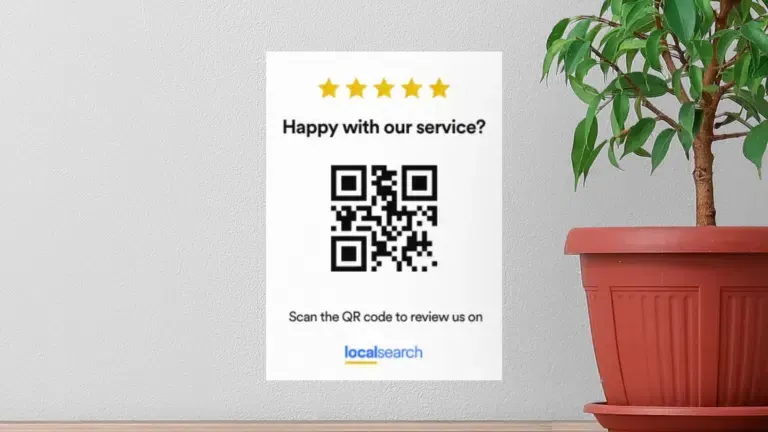
1. Google reviews. This is the single highest-value QR code an SMB can deploy. Inside your Google Business Profile dashboard there's a "Get more reviews" button that generates a short link to your review form. Turn that link into a QR code, stick it on the receipt, the menu cover, the invoice, the back of the business card. Customers scan, write a review, leave. Five-star reviews are the biggest single ranking factor in local search and the biggest single conversion factor on your profile.

2. Booking page. If you take bookings online, get the QR code to your booking page on every printed touchpoint customers see, your shopfront window, your business card, your vehicle signage.

3. Wi-Fi access. Cafés, salons, hairdressers, gyms. Customers connect without asking for the password. Removes a small annoyance and looks professional.

4. Menu, services list or price list. Restaurants and cafés moved to QR menus during COVID and a lot have stuck with them. Beyond hospitality, any business with a long service list benefits, physio clinics, mechanics, mobile detailers.

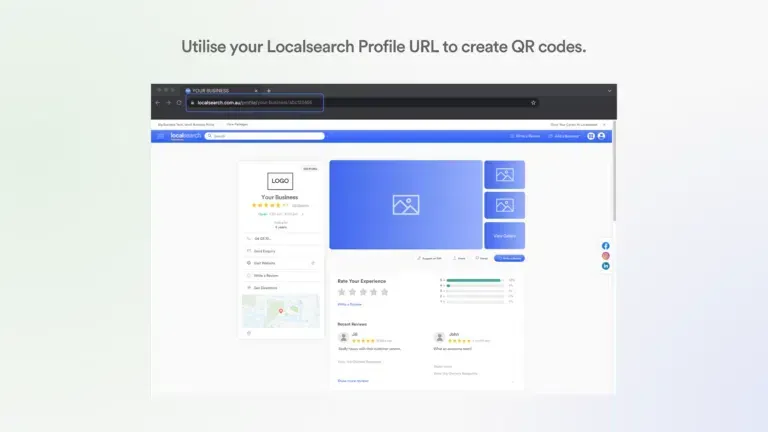
5. Localsearch and social profiles. A QR code on every printed surface that takes customers to your Localsearch business profile or your Instagram. Removes the friction of "what's your handle again?"

6. Contact card (vCard). A QR code on the back of your business card that loads your full contact details into the customer's phone with one tap. Beats hoping they'll manually type your number in.

5 free QR code generators that actually work in 2026

Most "free" QR code generators are freemium traps, codes that expire after a trial, watermarks on the output, surprise charges on the credit card you handed over. These five are genuinely free for what an Australian SMB actually needs.

1. QRCode Monkey

qrcode-monkey.com is the most-recommended free generator in 2026 reviews, and for good reason. Unlimited static codes, no signup, no watermark. Customise colours, embed your logo, change the eye shape and dot pattern. Download in PNG, SVG, EPS or PDF. The SVG/EPS export matters if you're printing anything larger than a sticker, vector files scale without going pixelated.

2. Canva

If you're already designing flyers, posters or business cards in Canva, the QR code generator is built directly into the design tool. Paste a URL, click generate, drop it straight into your design. Free, unlimited, static codes only. The catch: it requires a Canva account and the QR code lives inside your Canva design, you can't easily download just the code by itself. Best if Canva is already part of your workflow.

3. Adobe Express

adobe.com/express offers a free QR code generator that creates unlimited static codes with logo embedding. Slightly more polished than the dedicated tools, and the integration with the wider Adobe design ecosystem matters if you're already using Adobe products.

4. goQR.me

goqr.me is the no-fuss option. No account, no signup, no email required. Enter your URL, download the PNG. The interface looks like it was last redesigned in 2012 but the codes work and that's what matters. Best for one-off codes when you don't want to hand over an email address.

5. The QR Code Generator (TQRCG)

the-qrcode-generator.com offers the most generous free tier including two free dynamic QR codes, useful if you want scan tracking without paying. Static codes don't require signup. Dynamic codes do. Worth knowing if you decide you want analytics on a campaign without committing to a paid plan.

How to actually get customers to scan your QR code

Generating a QR code is the easy bit. Getting people to scan it is the part most businesses fluff.

Tell them what they get. A QR code with no context next to it gets ignored. "Scan to leave a Google review" works. "Scan to see today's specials" works. A naked QR code sitting on the counter doesn't.

Make it big enough. The minimum size for reliable scanning is roughly 2cm x 2cm on print. Bigger if it's on something people view from further away (a window, a sign on a wall). If anyone needs to lean in to scan it, it's too small.

Test it before you print. Print one copy first. Scan it with three different phones, iPhone, Samsung, an older Android. If any of them struggle, the code needs to be bigger or higher contrast. Doing this once before printing 500 flyers will save you from a very expensive mistake.

Put it where the customer already is. The back of the receipt, the menu cover, the docket invoice, the chair-back, the table tent. Not buried on the wall behind the counter.

Black on white is fine. Don't overdesign the code itself. Coloured QR codes look great until they don't scan reliably on a phone with auto-brightness battling sunlight.

Frequently asked questions

How do you scan a QR code?

Most smartphones from 2018 onwards can scan QR codes through the built-in camera app. Open the camera, point it at the code so the whole code fits in the frame, wait a second or two, and a notification will pop up at the top of the screen with the link. Tap to open.

Do you need an app to scan a QR code?

No, not for any iPhone or current Android phone. Older phones without native scanning can install a free QR reader from the App Store or Google Play. But this is rare in 2026, most phones handle it natively.

Is it free to generate a QR code?

Yes, for static QR codes. Every generator above offers unlimited static codes for free. Dynamic codes (the ones that track scans and let you change the destination) usually require a paid plan, though some platforms like TQRCG offer a couple of free dynamic codes.

Do QR codes expire?

Static QR codes never expire, they encode the destination directly. Dynamic QR codes can stop working if you stop paying for the service or if the company shuts down. This is the main risk of going dynamic for anything you're printing permanently.

Can we run out of QR codes?

No. A standard QR code can encode trillions of unique combinations. Running out is mathematically not going to happen.

What does "QR" stand for?

Quick Response. Invented in 1994 by Denso Wave to track car parts during manufacturing, now everywhere because of pandemic-era menu scanning.

QR codes work best when they're part of a wider strategy for getting customers to find and trust your business. A QR code on your business card pointing to a half-finished Google profile, an outdated website or a Localsearch listing that hasn't been touched in three years isn't helping. Get the destinations right first, then plaster the QR codes everywhere.

Want help getting your online profiles working harder? Talk to Localsearch about how local SEO, reviews and a properly-managed Google Business Profile can turn QR code scans into actual customers.

Stay in the loop

Get the playbook in your inbox

One email a month with the marketing tactics that are actually moving the needle for Australian small businesses. No fluff, no spam.

By subscribing, you agree to our Privacy Policy.

Protected by reCAPTCHA, Privacy & Terms.

Ready to grow?

Show me how to be found

Tell us a few things and a local specialist will be in touch to arrange your strategy session.

By submitting, you agree to our Privacy Policy.

Protected by reCAPTCHA, Privacy & Terms.